“PERCOUR - Persons, Offices and Networks at the French Court
Duration: 2017-...
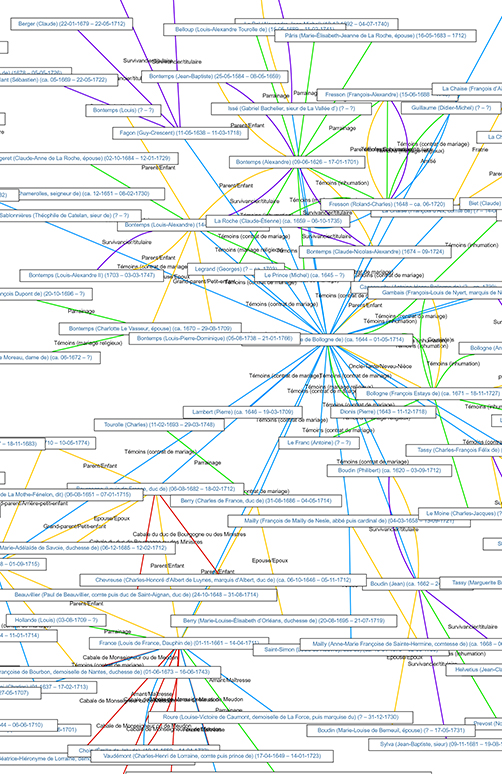
The prosopographical strand “PERCOUR” of the research program “Networks and Sociability at the Court of France, Seventeenth and Eighteenth Centuries” aims to create, develop, and provide data, research, and digital tools to reconstruct, document, and analyze the world of the court through its actors, their roles, and the relationships they maintained with each other. It is based on the idea that a detailed understanding of court society requires starting with individuals, offices, office successions, alliances, and trajectories to reveal the deeper structures that organized court life.
The court was a highly dense social milieu, bringing together around the sovereign and the royal family a heterogeneous body of office-holders whose service ensured the day-to-day functioning of the monarchy. Within this microcosm, proximity to the prince, the exercise of office, the possibility of holding multiple offices, marriage alliances, and the transmission of offices encouraged the formation of genuine court dynasties. The purpose of this strand is precisely to reconstruct these human configurations in order to understand how networks were formed, how positions circulated, and how influence, credit, and authority were concretely distributed within royal and princely households.
This approach makes it possible to study individuals and groups together, singular careers and collective logics alike. It seeks to provide a better understanding of how offices were recruited and transmitted, the formation of service dynasties, marriage strategies, geographical roots, professional solidarities, the holding of multiple offices, and the internal hierarchies within royal and princely households. Through these investigations, it becomes possible to identify more clearly the mechanisms of social advancement, family continuities, and forms of influence that durably structured the court.
The main achievement of this project is the Prosocour database, created as a research, organization, and analysis tool for prosopographical data on officers of royal and princely households. It gradually consolidates information on offices, their histories, their successive holders, biographical details about the individuals involved, and the various types of links that connect them. It functions both as a working tool for the research team and as a platform for scholarly dissemination, allowing broader exploration of court society.
The ambition of this strand is not merely to assemble individual entries. It is also to produce an analytical framework capable of highlighting regularities, circulations, and relational configurations at different scales. The prosopographical approach thus enables a shift from documentary accumulation to a genuinely historical reading of court networks by articulating biographies, service structures, and social dynamics.
Lastly, this strand is embedded in a resolutely collaborative logic. The construction of the data, its enrichment, verification, and interpretation rely on the joint work of members of the Centre de recherche du château de Versailles, external contributors, and scholarly partners. This collective dimension makes the prosopographical strand an evolving undertaking, intended to be continually enriched over the course of research, source surveys, and collaborations.
Main fields of enquiry
 nomenclature and definition of court offices;
history and continuity of offices;
modes of transmission and acquisition;
typology of networks;
networks of influence and coteries;
mechanisms of social advancement;
internal hierarchies and divisions within households;
identification of dynasties and dominant families.
nomenclature and definition of court offices;
history and continuity of offices;
modes of transmission and acquisition;
typology of networks;
networks of influence and coteries;
mechanisms of social advancement;
internal hierarchies and divisions within households;
identification of dynasties and dominant families.
Team
Coordination: Benjamin Ringot, Head of Research, Events and Teaching at the Centre de recherche du château de Versailles.
Researchers:
- Bastien Coulon, research officer, Centre de recherche du château de Versailles;
- Mathieu da Vinha, director, Centre de recherche du château de Versailles;
- Mathilde Deroin, research officer, Centre de recherche du château de Versailles;
- Delphine Desbourdes, research officer, Centre de recherche du château de Versailles;
- Sandrine Jauneau, research officer, Centre de recherche du château de Versailles;
- Flavie Leroux, research officer, Centre de recherche du château de Versailles;
- Cyril Pasquier, research officer, Centre de recherche du château de Versailles;
Productions
Online publication of the Prosocour prosopographical database on networks and sociability at the Court of France in the seventeenth and eighteenth centuries;
Continuous enrichment of the CRCV biographical database through systematic surveys of officers’ rolls, parish registers, and notarial deeds;
Article by Delphine Desbourdes, « De la Touraine à Versailles : carrières et réseaux des Amboisiens officiers commensaux du roi (XVIIe -XVIIIe siècles) », in Anne-Marie Cocula et Michel Combet (dir.), Servir le château, Bordeaux : Asonius éditions, 2025.