Prosocour Database (networks and sociability)
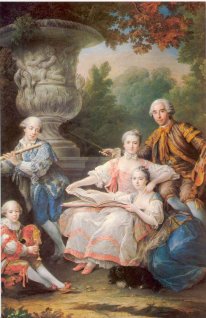
This database is part of the “Networks and sociability at courtof France, 17th-18th centuries” research programme led by the Centre de recherche du château de Versailles, under the direction of its Director, Mathieu da Vinha.
Access directly to the Database (in French).
This evolving database consists primarily of a list of the offices of all the royal households of the French court and their members. As the project progresses, data is added regarding the chronological record of such offices, the succession of their holders, biographical information and the different types of connections between individuals, etc.
The purpose of this tool is thus to capture and analyse prosopographic data in order to better understand the networks that were woven at court, the mechanisms of social ascension and the hierarchy of the royal households.
The chronological field covered span from the personal reign of Louis XIV (1661) to the end of the Louis XVI period (1792).
The research data management solution Polaris OS, developed by MyScienceWork, has been chosen by the CRCV to set up the navigation, research and analysis platform.
This database has been accessible online since 2024.
Publication
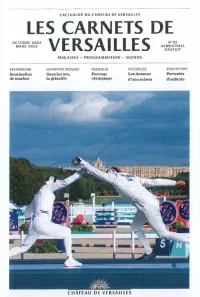
- Ringot (Benjamin), « Le Who’s Who de la cour », Carnets de Versailles, October 2024-March 2025, p. 09-11.
Presentations at symposia, study days and seminars
- Desbourdes (Delphine), “De la Touraine à Versailles : carrières et réseaux des Amboisiens officiers commensaux du roi (1650-1750)”, symposium Servir le château (Rencontres d’archéologie et d’histoire en Périgord) (Périgueux), September 27, 2024.
- Da Vinha (Mathieu), “Prosocour : base sur les réseaux et la sociabilité à la cour de France aux XVIIe et XVIIIe siècles”, study day Databases on 18th Century France: Cooperation and Exchanges (université de Trèves, online), September 5 and 23, 2024.
- Ringot (Benjamin), “Autour du service domestique (I) : présentation de la base de données Prosocour sur les officiers des maisons royales et princières à la cour de France (fin XVIIe-fin XVIIIe siècle)”, seminar Versailles une histoire en perspective (université de Versailles Saint-Quentin-en-Yvelines – Laboratoire DYPAC), November 7, 2022.
Press
- Archassal (Pierre-Valéry), « Prosocour, la base des charges de la cour de France », La revue française de la généalogie, 08-28-2024, online.
- Devillard (Arnaud), « Prosocour, une exploration interactive de la cour à Versailles », Sciences et avenir, 30-04-2024, online.
Exclusive patronage
Founded by Dr Adrian Cheng in 2018, the K11 Craft & Guild Foundation (KGC) is a registered charity in Hong Kong. We are dedicated to the preservation and revitalisation of rapidly disappearing Chinese crafts. Through national and international cultural projects, we promote research, revitalisation, education, exchange and interdisciplinary collaboration centred on traditional craftsmanship and Chinese culture. This helps to anchor traditional craftsmanship in the present, connect Chinese culture and aesthetics with the wider world, train the next generation, and ensure the sustainable conservation and development of traditional crafts.
Since its inception, KCG has supported over 100 artisans and organised more than 20 exhibitions, including the large-scale touring exhibition ‘K11 Voyage de Savoir-faire’, as well as the exhibition ‘The Four Seasons Recipe of The Cao’s’, which explores the aesthetics of the Chinese art of living through *Dream of the Red Chamber*. We have also undertaken cross-disciplinary international collaborations with over 100 brands and institutions, including the UBS Group, the LVMH Group, Vacheron Constantin and Cartier, with the aim of integrating culture and commerce and building a cultural ecosystem dedicated to the arts and crafts.
Building on this commitment, KCG sought to support the “Prosocour” online database by becoming its exclusive patron, thereby enabling its development and wider reach, particularly through research into French artisans serving the royal court.

KCG’s support for research into artisans working in the service of the Crown is now being extended with the online publication of the bilingual booklet “Courtly Arts. Artisans, Expertise and Excellence at Versailles in the 17th and 18th Centuries”, dedicated to the arts and crafts, craftsmanship and artisan dynasties of the Court of Versailles.

Database team “Prosocour”
Contributors from the CRCV
- Bastien Coulon, Research Officer, Centre de recherche du château de Versailles;
- Mathieu da Vinha, Director, Centre de recherche du château de Versailles;
- Mathilde Deroin, Research Officer, Centre de recherche du château de Versailles (since October 2025);
- Delphine Desbourdes, Research Officer, Centre de recherche du château de Versailles;
- Jehanne Fleury, External researcher (since July 2021);
- Sandrine Jauneau, Research Officer, Centre de recherche du château de Versailles;
- Nicole Lallement, Documentary Studies officer, Centre de recherche du château de Versailles (until Dec. 2020);
- Flavie Leroux, Research Officer, Centre de recherche du château de Versailles;
- Cyril Pasquier, Research Officer, Centre de recherche du château de Versailles;
- Isabelle Pluvieux, Head of Department, in charge of the databases, Centre de recherche du château de Versailles;
- Benjamin Ringot, Head of the Research, Conferences and Teaching Department, Centre de recherche du château de Versailles ;
- Natasha Shoory, Research Officer, Centre de recherche du château de Versailles (October-November 2024), and independent researcher (March-October 2025).
Interns CRCV
- Jehanne Fleury, intern, École nationale des Chartes (March-end of June 2021);
- Cloé Véron, intern, CY Cergy Paris Université (January-July 2023);
- Mathilde Deroin, intern, École des hautes études en sciences sociales (March-July 2024).
Partners CRCV
During its design phase, the Prosocour database benefited from the expertise in digital humanities and digital and quantitative tools for processing historical data of Stéphane Lamassé, a lecturer in Medieval History, and Julien Alérini, a certified professor, both from our partner University of Paris 1 Panthéon Sorbonne.
Since its launch, Prosocour has also benefited from the expertise and advice of Thomas Fressin, Doctor of Modern History and associate lecturer in computer science at Gustave Eiffel University, in terms of its user-friendliness, data export and visualisation.
External contributors
The project “Prosocour” is firmly based on a collaborative work ethic, using collective intelligence in pursuit of research. This policy has established a model based on openness and cooperation involving active contributions from external contributors – researchers, archivists, genealogists, connoisseurs and enthusiasts – who fall into two different categories according to their level of involvement in the project:
 External contributors: bring data that enriches the “Prosocour”. knowledge base. These sourced contributions are then validated and entered by the team at the Research Centre, thus diversifying and broadening the scope of the study, and strengthening the representativeness of the results obtained.
- External contributors team: Thierry Caillaud; Jean Catherine; Lucy Crockett-Fresson; Éric de Fontgalland; Isabelle Lefebvre; Laurent Maille; Maurice Sarazin.
External contributors-data enterers: bring data and help to enter it directly in “Prosocour”. By actively contributing in this way, they help to speed up the process of entering data and strengthen the feeling of being part of a collective initiative.
- External contributors-data enterers: Isabelle Coquillard, holder of a PhD from l’université Paris Nanterre, associate member of the Laboratoire MéMo, enters data about doctors based on her research into the doctor regents of the Paris faculty of medicine of the 18th century; Jehanne Fleury, doctoral student at l’université Versailles Saint-Quentin-en-Yvelines, external researcher at the Centre de recherche du château de Versailles, enters data on the topic of royal female households from duchesse de Bourgogne to Marie-Antoinette.
This collaborative approach means that “Prosocour” is a federative project that promotes dialogue and scientific co-construction, where pooling of effort and resources is one of the keys to obtaining reliable, relevant results.